
.png?width=40&height=40&name=search%201%20(1).png)
The 2025 SANS OT Report, authored by Jason D. Christopher, provides a clear snapshot of where OT cybersecurity is improving and where it’s still struggling. Detection and containment are trending in the right direction, with nearly half of incidents detected within 24 hours and around 60% contained within 48 hours. But visibility continues to be the major weak point in ICS/OT environments.
Asset visibility drops sharply deeper into the control network, especially across SCADA/HMI, PLCs, and remote or unmanned sites. Threat-intelligence adoption remains low, and remediation often takes far too long, sometimes over a month, mostly because teams lack a reliable baseline of “normal” operations. For organisations running critical infrastructure, the visibility gap creates real risk around safety, operations, compliance, and financial stability.
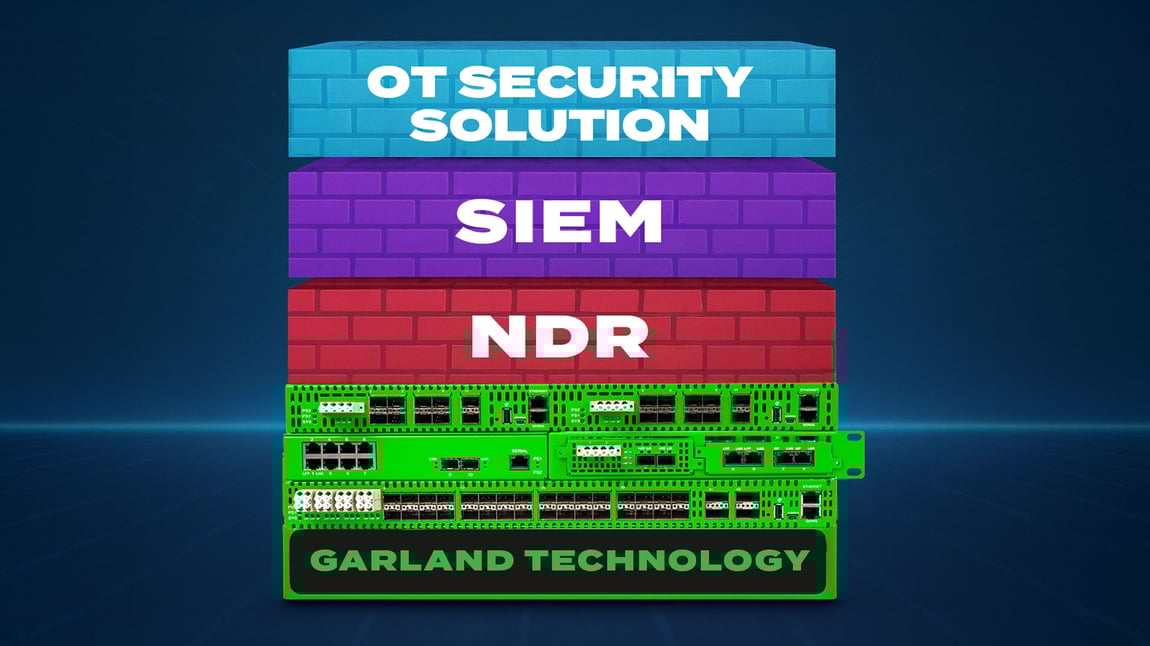
This is exactly where Garland Technology helps. Garland Technology’s hardware solutions strengthen the visibility foundation beneath the rest of the OT security stack.
The SANS OT 2025 data shows improving detection and containment, but the same root issue persists: most teams still can’t see what’s happening inside their OT networks. Visibility is often acceptable at the perimeter, then drops away rapidly once traffic enters SCADA zones, HMIs, PLC racks, and remote field sites.
That blind spot drives most of the challenges the report calls out. If you can’t see the network or how it behaves, then detection, segmentation, threat intel, and incident response all become more difficult than they need to be.
Packet-level visibility gives you real data - not assumptions. With proper access to the wire, you can:
Visibility is the foundation for every OT security control. When the data is real, everything improves.
Most ICS blind spots live inside the control network, which is also where the highest consequence events occur and where monitoring is weakest. Using Network TAPs, Network Packet Brokers, and Hardware Data Diodes from Garland Technology, you can safely extract traffic and gain visibility into:
This gives teams the ability to monitor the zones that matter most, where small changes can have major operational impact.

Threat intelligence only becomes useful when you can map indicators to your actual ICS environment. Without visibility, intel stays theoretical.
When you can see your assets, traffic patterns and protocol behaviour, you can align threat intel to:
This sharpens detection rules, grounds segmentation decisions, and makes patching prioritisation risk-based rather than date-based. Without packet-level clarity, none of that works.
The SANS report shows remediation timelines still stretching into weeks. Most of that delay comes from responders having to reconstruct “normal” behaviour because no baseline exists.
Consistent OT visibility helps responders:
It reduces guesswork and shortens recovery times significantly.
Regulated sites consistently perform better because visibility is mandated. Once monitoring points are in place, compliance checks become easier and far more repeatable. The same visibility data can feed resilience planning, business continuity, and fault-tolerance work, without maintaining duplicate processes.
The 2025 SANS OT Report reinforces a simple truth: all meaningful OT cybersecurity improvements start with visibility. You need to see what’s on the network, how it communicates, where risks sit, and whether segmentation behaves the way you think it does.
Garland Technology provides the hardware foundation - at Layer 0, Layer 1 and Layer 2 - to collect that data safely and consistently.
When you can see your OT network clearly, everything else becomes far easier — and you can move forward with much more confidence.
Looking to add visibility to your OT cybersecurity projects, but not sure where to start? Join us for a brief network Design-IT evaluation or demo. No obligation - it’s what we love to do.
This article draws on insights from the 2025 SANS State of ICS/OT Security Survey by Jason D. Christopher. Credit to the author and SANS Institute.